
Why Do Pressure Cooker Handle Parts Wear Out?
Pressure cooker handle parts face repeated heat, weight, moisture, and movement. Each cooking cycle warms the handle area, then cools it again. Over time, that change can stress plastic, loosen fasteners, or wear the joint where the handle meets the pot. A small wobble may seem harmless. It can be an early warning.
Component-design specialist Maya Chen captures the concern this way: “A handle rarely wears out from one moment; repeated heat and movement leave clues.” Those clues may include hairline cracks near screw holes, a loose grip, faded or rough surfaces, or a handle that shifts when lifted. The exact cause depends on the cooker’s materials, design, age, and use. A damaged handle should not be treated as a cosmetic problem.
This article explores why pressure cooker handle parts wear out, what common signs reveal, and which habits may shorten their service life. Heavy loads, impacts, harsh cleaning, and loose fittings can all contribute. So can ordinary aging. The details matter. A handle that feels less secure deserves attention before the next meal. Check the manufacturer’s care instructions, and stop using the cooker if its handle is cracked, unstable, or detached. Replacing a worn part with a compatible component can restore safe handling, but guesswork is not a repair plan.
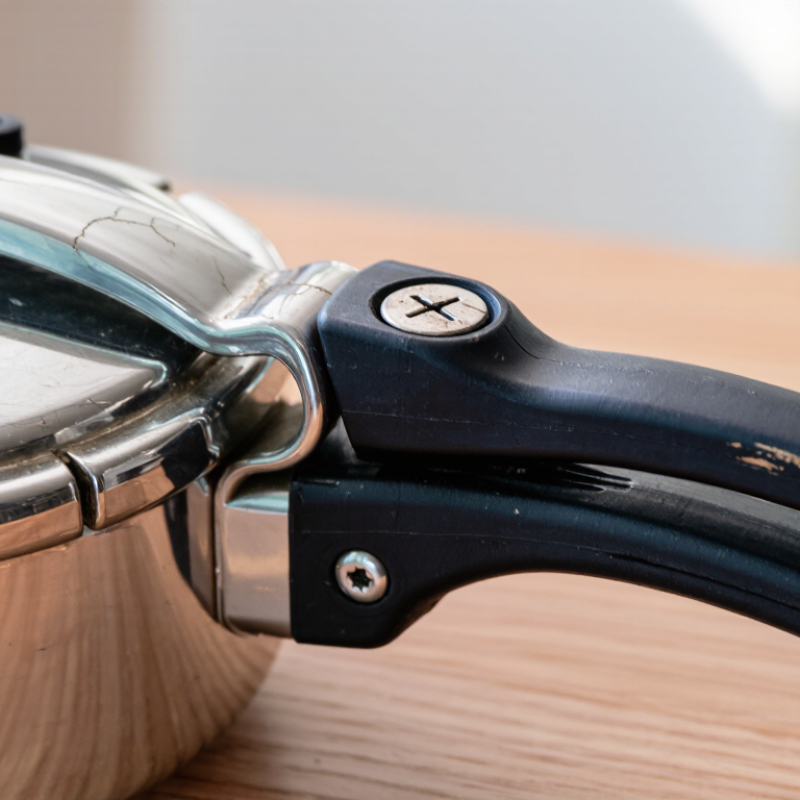
Handle Materials and Heat Paths: Identify Polymer, Metal, and Fastener Parts
A pressure-cooker handle is usually a small thermal system: a polymer grip, metal supports, and screws or pins joining them. These parts age differently. The ASM Handbook lists thermal conductivity around 15 W/m·K for common austenitic stainless steels and roughly 200 W/m·K for aluminum alloys. Unfilled polypropylene, by comparison, is typically near 0.1–0.2 W/m·K in engineering-property databases such as MatWeb. Heat therefore travels readily along a metal bracket, but much more slowly through the grip. That contrast matters.
Look closely at the junction. A metal insert touching the lid can conduct heat toward a fastener, creating a warm spot beneath an otherwise cool-looking polymer shell. Steam, repeated heating, and slight handle movement can then stress screw holes and polymer edges. A loose fastener may let the grip flex; a cracked grip may expose the metal path. Not every discoloration means overheating, though. Polymer grade, wall thickness, and cooking conditions all affect wear. Even so, a glossy, softened patch near a screw deserves attention. Inspect only after the cooker has cooled, and check for looseness, cracks, or sharp edges. Thermal conductivity figures are typical room-temperature values, not a prediction of a particular handle’s service life.
Why Do Pressure Cooker Handle Parts Wear Out? - Handle Materials and Heat Paths: Identify Polymer, Metal, and Fastener Parts
| Part or area | Common material | Likely heat path | Typical wear or failure | What to inspect |
|---|---|---|---|---|
| Main grip shell | Heat-resistant thermoplastic, such as glass-filled polyamide, or a thermoset such as phenolic resin; materials vary by design. | Heat may travel from the lid or pot through the mounting area and into the grip. Steam and hot surfaces can also warm exposed areas. | Repeated heating and cooling can contribute to aging, brittleness, distortion, or surface cracking. Impacts and harsh cleaners may add damage. | Look for cracks, chips, looseness, distortion, or a grip that has become unusually brittle. Do not use a damaged handle. |
| Metal mounting plate or bracket | Often stainless steel, aluminum, or coated steel, depending on the cooker construction. | Metal can conduct heat from the lid or vessel toward the handle attachment; the amount depends on geometry, contact, and any insulating spacers. | Repeated thermal cycling can stress joints. Corrosion or deformation may occur if the part is exposed to moisture, salts, or impact. | Check for visible corrosion, bending, gaps, or movement at the attachment. Do not bend or modify the bracket. |
| Screws, bolts, and threaded inserts | Commonly steel or stainless steel fasteners; some designs use metal inserts embedded in a polymer handle. | Fasteners can form a small conductive path between the mounting surface and the handle assembly. | Thermal cycling, vibration, corrosion, or damaged threads can contribute to a loose connection. Over-tightening can strip polymer threads or crack surrounding material. | Check for missing, visibly corroded, or loose fasteners. Follow the cooker’s instructions for tightening; avoid improvised screws. |
| Insulating spacers or washers | May be polymer, silicone, or another heat-resistant insulating material; not all designs include separate spacers. | A spacer can reduce direct metal-to-handle contact, although it does not eliminate heat transfer. | Compression, aging, displacement, or loss during disassembly can change the fit and heat path. | Look for a missing, split, flattened, or displaced spacer. Replace only with the specified part. |
| Handle-to-lid contact area | A combination of the lid material, handle polymer, and any metal mounting hardware. | Direct contact, metal fasteners, and the thickness of the handle base affect how heat reaches the grip. | A poor fit, trapped residue, or a loose joint can increase movement and local stress; heat felt at the grip can have several causes. | Check that the handle sits flush and does not rock. Follow the manufacturer’s guidance if the handle becomes unusually hot. |
| Cleaning and storage exposure | Affects polymer surfaces, coatings, metal parts, and fasteners. | Repeated cooking heat combines with exposure to water, detergent, food residues, and storage conditions. | Abrasive pads or unapproved chemicals can scratch surfaces or damage finishes; moisture left around joints can encourage corrosion in susceptible metals. | Use the care instructions, clean and dry the handle area, and avoid abrasive tools or chemicals not approved for the cooker. |
Materials and construction differ among pressure cooker models. If a handle is cracked, deformed, loose, or otherwise damaged, stop using the cooker until the part has been checked or replaced according to the manufacturer’s instructions.
Related Posts
-
Top Pressure Cooker Replacement Options for Global Buyers
-
China Best Pressure Cooker Replacement Parts Supplier?
-
Why Choose Fagor Pressure Cooker Parts for Global Buyers?
-
How to Replace a Float Valve for Pressure Cooker?
-
2025 Top 5 Pressure Cooker Replacement Valves for Efficient Cooking
-
Top 10 Pressure Cooker Washer Parts You Need to Buy Now?