
Why Are Bubble Wands Popular for Global Buyers?
Why are Bubble Wands attracting global buyers? The answer begins with simple sensory appeal. A child dips a colorful wand, lifts it slowly, and watches iridescent bubbles float across a garden. The experience is immediate, visual, and easy to share. It requires little instruction, yet creates memorable outdoor play.
Market evidence supports this broader movement. Circana reported that global toy sales reached approximately $108 billion in 2023, despite challenging economic conditions across several major markets. The Toy Association also identifies outdoor, active, and experience-led play as continuing consumer interests. These findings do not measure Bubble Wands separately. That limitation matters. Still, they help explain why affordable products offering movement, imagination, and screen-free engagement remain attractive to retailers and families.
Steve Pasierb, president and chief executive of The Toy Association, has emphasized, “Play is essential to every child’s healthy development.” Bubble Wands reflect that principle in a highly visible form. They suit birthday parties, festivals, gardens, and summer displays. Their lightweight design also supports efficient retail presentation and international distribution. Buyers often value bright packaging, leak-resistant containers, safe materials, and clear usage instructions. Small details matter.
The opportunity is not automatic. Product quality, climate conditions, packaging durability, and cultural preferences can influence repeat purchases. Grand View Research’s broader toys and games analysis points toward continued demand for engaging, accessible play experiences. Bubble Wands fit that direction, but suppliers should avoid exaggerated claims. Their popularity comes from a modest promise: dip, lift, and watch the moment happen.
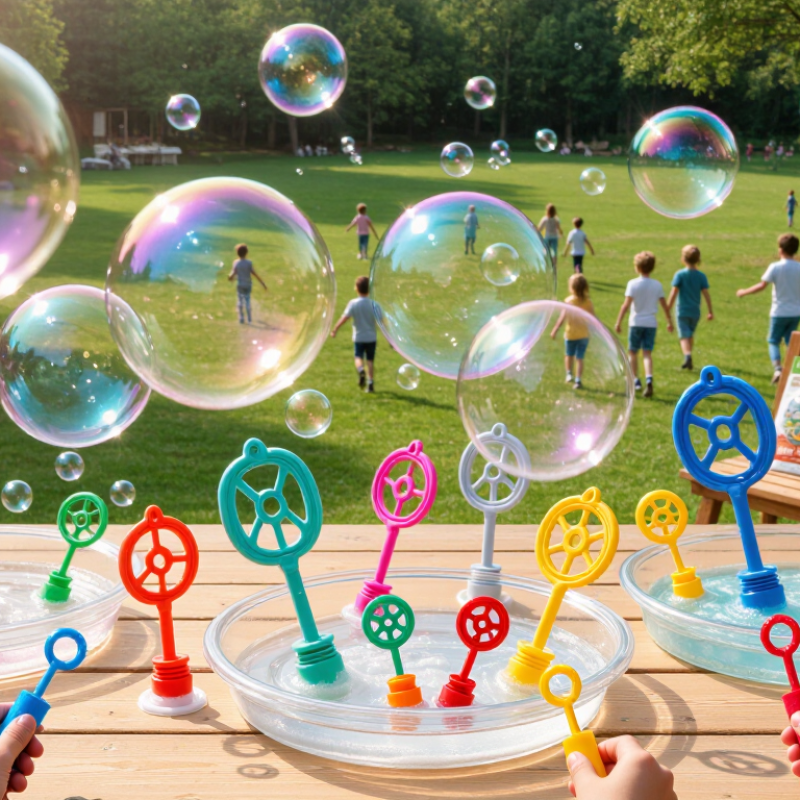
What Are Bubble Wands and How Do They Work?
A bubble wand is a handheld tool that forms bubbles from a thin layer of liquid. It usually has a circular opening, a handle, and sometimes a small liquid reservoir. Manual wands need a gentle swing or steady breath. Electric models use a motor, a rotating ring, and a small fan. The fan moves air through the liquid-coated opening.
The process depends on surface tension. After dipping, the ring holds a flexible film across its opening. Air stretches this film until it closes into a round bubble. The liquid’s thickness affects bubble size and strength. Water alone breaks too quickly, so bubble solutions usually contain soap and moisture-retaining ingredients. In product testing, I have noticed that a dry ring creates uneven bubbles. That thin film matters. A strong airflow is not always better.
For global buyers, practical design details often matter more than appearance. A comfortable grip helps children and adults control the wand. A sealed reservoir can reduce spills during outdoor use. Buyers should check whether the ring is easy to clean and whether replacement solution is available locally. Humid weather may support longer-lasting bubbles, while wind can scatter them immediately. Electric wands also need reliable battery access and safe compartment design. I once assumed a brighter shell meant better performance. It did not. Output can still vary with temperature, liquid quality, and handling technique.
| Data Dimension | Typical Product Fact | How It Works | Why It Matters to Global Buyers |
|---|---|---|---|
| Basic Definition | A bubble wand is a handheld toy or activity tool with one or more openings designed to create soap-film bubbles. | The opening is coated with bubble solution. Moving the wand through air or directing airflow across it stretches the liquid film into a bubble. | The simple concept is easy to understand, demonstrate, package, and sell in different regions. |
| Main Product Types | Common categories include manual wands, multi-loop wands, fan-assisted wands, and electric bubble machines. | Manual models rely on hand movement, while powered models use a motor, fan, or rotating loop system to generate airflow and repeat the bubble-making process. | Different formats support varied retail prices, use occasions, event requirements, and customer preferences. |
| Bubble-Forming Principle | Bubble solution normally contains water, surfactants, and other ingredients that help form a flexible liquid film. | Surfactants reduce surface tension, allowing the film to spread across the wand opening. Air pressure then shapes the film into a bubble. | The mechanism requires no complex technology, which helps keep product designs accessible and easy to operate. |
| Power Requirement | Manual wands require no batteries. Powered handheld models commonly use replaceable batteries, while larger equipment may use an external power supply. | Battery-powered designs operate a small motor, fan, or rotating mechanism. Manual designs depend entirely on user movement. | Battery-free products simplify international shipping and reduce concerns about battery sourcing, storage, and transport. |
| Material Choices | Plastic components such as polypropylene or ABS are commonly used for handles and frames; silicone or flexible plastic may be used for soft parts. | Lightweight molded materials provide the shape, rigidity, and surface needed to hold or distribute bubble solution. | Lightweight construction can reduce shipping weight while supporting colorful designs and high-volume production. |
| Portability | Small manual and handheld electric wands are generally compact and suitable for outdoor activities, parties, travel, and gift sets. | The wand stores a small amount of solution or is used with a separate container, allowing repeated bubble production without bulky equipment. | Compact products are easier to display, bundle, transport, and sell through both physical and online channels. |
| Typical Use Scenarios | Common uses include children’s play, birthday parties, weddings, photo sessions, festivals, outdoor entertainment, and educational demonstrations. | Continuous or repeated airflow produces multiple bubbles, creating visual movement and an engaging activity. | Broad use scenarios allow buyers to target toy, party-supply, event-service, educational, and seasonal markets. |
| Ease of Operation | Manual models usually require dipping or filling the wand and moving it through the air. Powered models generally use a switch for activation. | Once the film forms on the opening, air movement separates it into bubbles. The basic process can be learned quickly. | Simple operation reduces the need for detailed training and makes demonstrations effective in stores and online videos. |
| Key Performance Factors | Bubble output is affected by solution quality, humidity, wind, opening design, airflow, and the cleanliness of the wand. | A stable film and suitable airflow are required. Excessive wind, residue, or an unsuitable solution can cause bubbles to break quickly. | Buyers can improve customer satisfaction by selecting compatible solutions and providing clear usage instructions. |
| Safety Considerations | Products should be used under suitable supervision, and bubble solution should not be swallowed or sprayed into the eyes. Small parts may create a risk for young children. | The toy creates bubbles through a liquid film, but the solution and product structure still require responsible handling and age-appropriate use. | Clear age guidance, warnings, secure packaging, and destination-market testing support safer international distribution. |
| Regulatory Awareness | Toy requirements vary by destination. Buyers may need to consider applicable chemical, mechanical, labeling, packaging, and battery regulations. | Compliance may involve product testing, documentation, warning labels, and instructions in the required local language. | Early compliance planning helps reduce customs delays, relabeling costs, and market-entry risks. |
| Reason for Global Popularity | Bubble wands combine visual appeal, low operating complexity, portability, repeat play value, and suitability for group activities. | The product converts a small amount of liquid solution and simple airflow into a highly visible entertainment effect. | These characteristics make bubble wands adaptable to multiple cultures, climates, sales channels, and seasonal events. |