10 Best BPA Free Thermal Printer Paper Suppliers
Thermal receipts are still common in shops, clinics, cafés, and delivery counters. Choosing the right paper can affect print clarity, printer upkeep, and the customer’s experience. Bpa Free Thermal Printer Paper is one option for businesses seeking paper made without BPA, but the label alone does not tell the whole story. Roll size, core diameter, coating quality, and storage conditions also matter.
A reliable supplier should provide clear product specifications and answer practical questions. Ask about available widths, roll lengths, packaging, minimum order quantities, and documentation supporting product claims. If your printer handles long queues, test a sample during a busy shift. Check whether text stays sharp, the paper feeds smoothly, and rolls fit without repeated adjustments. Small details matter.
This guide to the 10 Best BPA Free Thermal Printer Paper Suppliers will help buyers compare options with care. It focuses on product information, communication, consistency, and ordering flexibility rather than broad promises. Supplier catalogs can look similar, and claims may not explain how paper performs in your specific printer. That deserves a closer look. Consider your daily print volume, storage space, and replacement schedule before placing a large order. A small trial order can reveal issues that a polished product page may miss. No supplier is automatically the best fit for every business. Use the criteria here to narrow your choices and verify important details directly with each supplier.
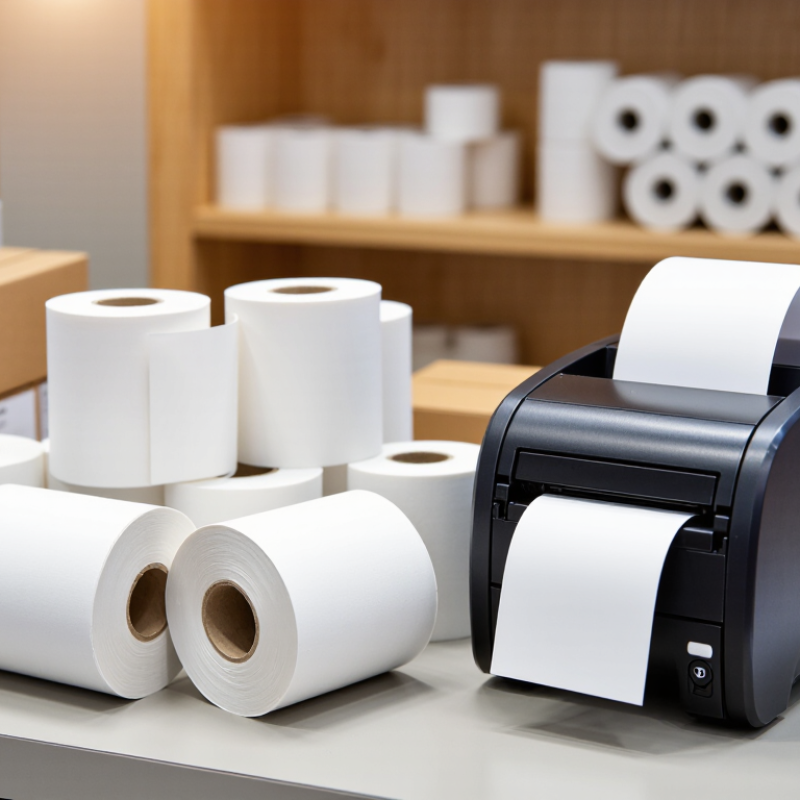
How BPA-Free Thermal Paper Works: The Heat-Sensitive Coating
Thermal paper prints without ink. Its surface carries a thin, heat-sensitive coating made from a colorless dye, a developer, and other ingredients. When the print head heats tiny spots, the coating softens and the dye reacts with the developer, forming dark text or images. The paper stays pale where it receives no heat.
BPA-free describes the absence of bisphenol A, not the absence of chemical developers. Some formulations use other substances, and performance can vary in darkness, fade resistance, and storage stability. The U.S. Environmental Protection Agency’s 2014 report, Bisphenol A Alternatives in Thermal Paper, assessed 19 potential alternatives. That review is a useful reminder: replacing one ingredient does not automatically make every substitute equally preferable. There is still room to ask better questions.
Tip: Ask suppliers to identify the coating developer and provide technical data for image stability and print-head performance. Test sample rolls in your actual printer, especially if receipts will sit under bright light or near heat. A crisp print today may fade later. Check it after storage, too.
How to Assess Suppliers: Compliance, Paper Specs, and Traceability
When assessing BPA-free thermal paper suppliers, ask for current test reports, not just a “BPA-free” statement. The European Union’s Commission Regulation (EU) 2016/2235 restricts BPA in thermal paper to 0.02% by weight, effective January 2020. This is a useful compliance benchmark, not proof that every market has identical rules. Check whether reports identify the tested product and batch, name the laboratory, and state the detection limit. “BPA-free” also does not necessarily mean phenol-free; request disclosure of the developer chemistry and any available testing for substitutes.
Paper specifications should match the printer and the job. Confirm roll width, core size, outside diameter, basis weight, and coating-side orientation. Ask for image-density and fade-performance results under stated storage conditions; vague claims like “long-lasting” are hard to compare. A sample roll can reveal coating dust, uneven darkness, or jams, though one sample is not a full quality program. Keep it practical.
Traceability makes those checks useful later. Request lot numbers on cartons, certificates of analysis linked to each shipment, and written notice when materials or production sites change. Industry guidance from the Forest Stewardship Council emphasizes tracking certified material through the supply chain; certification can support sourcing claims, but it does not establish BPA content. Some paperwork looks reassuring. Verify the details.
10 Best BPA-Free Thermal Printer Paper Suppliers: How to Assess Suppliers
A practical checklist covering compliance, paper specifications, and traceability.
How to use this chart: The counts represent a proposed screening checklist, not measured supplier results. Request compliance declarations and supporting test reports; verify paper details such as basis weight, thickness, roll dimensions, and print performance; and check that batch records link the finished rolls to production and material documentation.
10 Best BPA-Free Thermal Printer Paper Suppliers and Their Product Ranges
A useful comparison of ten BPA-free thermal paper suppliers should look beyond headline claims. Some specialize in jumbo parent rolls for converters, while others sell finished rolls to retailers and service companies. Their ranges may include common receipt widths, different roll diameters, and varied core sizes. Small details matter. A roll that does not fit a printer can cause daily delays.
Product catalogs often cover standard white direct thermal paper, with options for thicker stock or longer roll lengths. Certain suppliers also offer colored paper, custom widths, and packaging designed for bulk storage.
Ask whether the product is explicitly tested for BPA, and request current specifications or test documentation. BPA-free does not automatically mean free of every other phenolic developer. Check the exact claim.
Compare samples under real conditions. Print a receipt, handle it with dry and slightly damp fingers, and review how clearly the image develops. Ask about coating consistency, winding, shipment protection, and lot identification. These checks are practical, not glamorous. A broad range can look impressive, but I would not treat catalog size as proof of dependable quality. Supplier descriptions also vary, so written specifications make comparisons fairer.
How to Verify BPA-Free Claims: Review Test Reports and Safety Data Sheets
When comparing BPA-free thermal printer paper suppliers, do not rely on a website badge alone. Ask for a recent test report tied to the exact paper grade, roll size, and production lot. A credible report should name the tested substance, testing method, detection limit, sample description, and laboratory. Check whether the laboratory has recognized accreditation. A vague statement such as “BPA not detected” is incomplete without these details.
Review the safety data sheet carefully. It may identify coating ingredients, handling risks, and emergency guidance, but it might not list every component in a finished article. Some suppliers provide an SDS for the base paper instead of the coated thermal paper. That mismatch matters. I have seen paperwork that looked professional yet lacked a product code or test date. Small details can expose weak traceability.
Ask whether the supplier also tests related phenolic developers, such as BPS or other substitutes. BPA-free does not automatically mean free from every chemical of concern. Compare the report’s detection limits with your purchasing requirements, and request a written declaration for each shipment. Keep invoices, lot numbers, reports, and supplier replies together. My own review process is not perfect; documents can change after approval. Rechecking samples periodically is wiser than treating one report as permanent proof.