
Choosing the right Trash Can MANUFACTURER in 2026 requires more than comparing catalog prices. Global buyers need dependable production, stable material quality, and clear communication throughout each order.
A factory may display polished product photos. Yet the real test appears in the details. Does the lid close quietly after repeated use? Does the stainless steel resist fingerprints and corrosion? Can the manufacturer maintain color consistency across thousands of units? These questions matter for retailers, hospitality groups, offices, and distributors.
Frank Yang, founder of simplehuman, once said, “We make tools for efficient living.” That idea remains useful when evaluating modern waste containers. A reliable supplier should combine practical design with measurable manufacturing control. Look for documented inspections, tested components, realistic lead times, and responsive after-sales support. Certifications can strengthen confidence, but buyers should verify their scope and validity.
Small details reveal experience.
For international purchasing, packaging also deserves attention. A poorly protected pedal or dented body can turn a successful shipment into an expensive complaint. Strong export cartons, moisture protection, and clear labeling reduce avoidable problems. Custom sizes, sensor systems, recycling compartments, and smart features may add value, but complexity can also increase maintenance risks.
No ranking is perfect. A manufacturer that suits a supermarket chain may not fit a hotel project. Buyers should compare factory capability, minimum order quantities, tooling support, warranty terms, and communication quality. The best choice is not always the cheapest one. It is the supplier that delivers consistently, explains limitations honestly, and improves when problems appear. That standard gives this 2026 guide a practical foundation for global buyers.
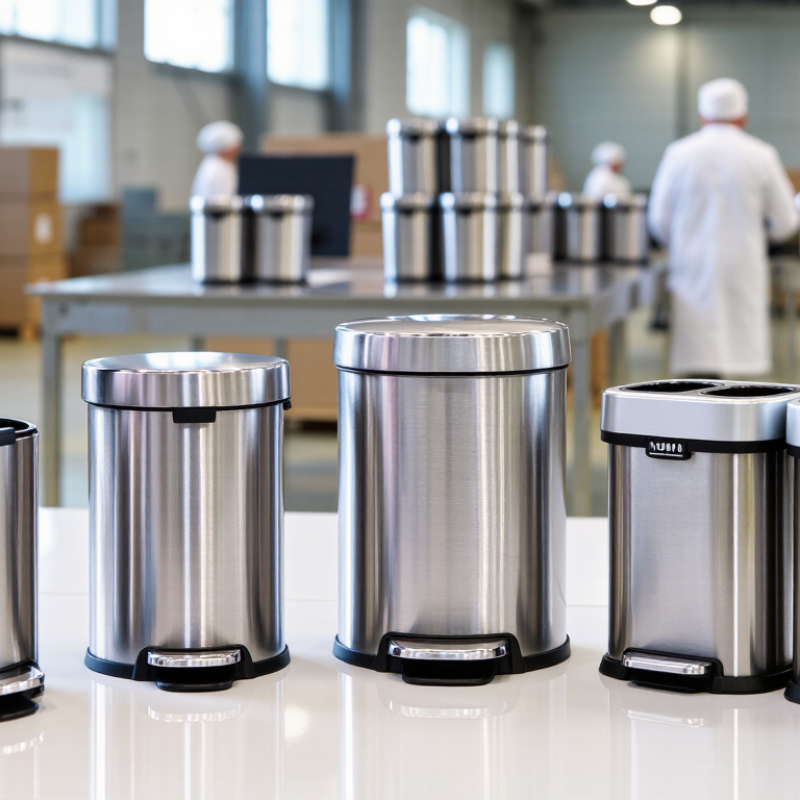
In 2026, the best trash can manufacturer is not simply the one offering the lowest price. Global buyers need evidence of consistent production, practical design, and dependable communication. A capable manufacturer should explain material grades, wall thickness, load limits, and testing methods clearly. For example, a 30-liter kitchen bin should open smoothly, resist fingerprints, and keep its lid aligned after repeated use.
Manufacturing experience becomes visible in small details. Strong pedal hinges, stable bases, removable liners, and tight odor-control seals reduce complaints after delivery. Reliable suppliers also inspect samples from every production batch, record test results, and protect products with suitable export packaging. A buyer should request photos, factory documentation, and a physical sample before approving a large order. Clear lead times matter too. Delayed containers can disrupt retail schedules and warehouse planning.
No manufacturer is perfect. That matters. The best choice is one that admits design limits and responds with measurable improvements. A supplier may discover a noisy hinge, a weak carton corner, or a finish that shows scratches under harsh lighting. Honest reporting builds more trust than polished promises. Buyers should review after-sales response, replacement procedures, and communication across time zones. Certifications can support credibility, but they should be verified rather than accepted blindly. Practical testing, transparent records, and steady cooperation often reveal more than impressive catalog language.
Global buyers need more than a low unit price when selecting a trash can manufacturer. The World Bank’s What a Waste 2.0 report estimates global waste could reach 3.40 billion tonnes annually by 2050. That forecast favors durable capacity planning, not decorative design. Key categories include indoor pedal bins, outdoor wheeled containers, recycling stations, and sensor-enabled units. Each serves a different workflow.
Pedal bins suit kitchens, clinics, and offices requiring hands-free access. Wheeled containers need reinforced axles, quiet casters, and UV-resistant bodies.
Recycling stations should use clear openings and consistent color coding. Sensor models can track fill levels, but batteries and connectivity add failure points.
UNEP’s Global Waste Management Outlook 2024 projects municipal waste could rise from 2.3 billion tonnes in 2023 to 3.8 billion by 2050.
For international purchasing, specify capacity, steel or polymer grade, liner retention, drain options, spare parts, and packaging tests. Check salt spray performance for coastal routes. Check wheel performance on uneven pavements.
Manufacturers should provide test records, material declarations, and traceable quality controls. Yet specifications are not enough.
A perfect sensor may be less useful than a simple bin that local staff can repair. This practical compromise is easy to miss.
2026 Best Trash Can Manufacturer for Global Buyers?
Choosing the right trash can manufacturer requires more than comparing prices. Manufacturing quality appears in details such as lid alignment, pedal strength, weld consistency, and surface finishing. Request production samples, not only showroom pieces. Test each sample repeatedly. A pedal that works smoothly five times may fail after five hundred cycles.
Factory capability also matters. Ask for monthly output, machine lists, workforce details, and recent production schedules. A manufacturer with several forming machines may still struggle during peak seasons. Verify capacity through factory visits, production videos, or independent audits. Review quality records and rejection rates when available. These documents are not always complete, but missing information deserves attention. A confident sales promise is not proof.
Tips: Check material thickness with a caliper. Inspect corners, hinges, and inner surfaces. Confirm whether capacity includes packaging and final inspection. Ask for a small trial order before committing to large volume. Keep written specifications for steel grade, dimensions, color, tolerance, and testing methods. I have seen buyers focus heavily on appearance and overlook carton strength. That mistake caused damaged units during transit. Production quality includes packaging, documentation, and consistent delivery. Even experienced buyers can miss one weak process.
2026 Best Trash Can Manufacturer for Global Buyers?
Global buyers need more than attractive trash cans. They need documented compliance, stable production, and dependable delivery. An experienced manufacturer should provide material declarations, safety test reports, and factory quality records. Requirements may differ across regions, so one certificate cannot prove worldwide conformity. Product specifications should match the destination market, including plastics, coatings, labels, and packaging.
Sustainability must be measurable. Recycled plastic content should have supplier evidence, not vague marketing language. Manufacturers can reduce impact through durable hinges, replaceable parts, compact packaging, and lower-waste production. ISO 14001 systems may support environmental control, while ISO 9001 procedures help manage consistency. Still, recycled materials can create slight color variation. Buyers should accept this risk or define clear limits.
Supply chain reliability depends on traceability. A capable factory should track resin batches, production dates, inspection results, and shipment documents. Independent audits can reveal labor, safety, or process weaknesses before they become costly problems. No factory is flawless. The useful question is whether it responds openly and corrects issues quickly. Strong suppliers also maintain backup material sources and realistic lead times. A low quotation means little when late shipments interrupt retail plans. Sample testing, pilot orders, and regular production checks give global buyers stronger evidence than promises alone.
| Evaluation Dimension | Recommended 2026 Benchmark | What Global Buyers Should Verify | Why It Matters | Typical Evidence |
|---|---|---|---|---|
| Quality Management | ISO 9001:2015 quality management system | Valid certification issued by an accredited certification body, defined inspection procedures, corrective-action records, and batch traceability. | Provides a structured framework for consistent production, complaint handling, process control, and continual improvement. | Current certificate, scope of certification, audit status, inspection plans, and nonconformity records. |
| Environmental Management | ISO 14001:2015 environmental management system | Documented control of waste, water, energy, emissions, hazardous substances, and environmental legal obligations. | Helps buyers assess whether environmental impacts are managed systematically rather than through isolated claims. | Certificate, environmental objectives, waste-transfer records, permits, and improvement results. |
| Occupational Health and Safety | ISO 45001:2018 occupational health and safety management system | Risk assessments for stamping, welding, painting, injection molding, assembly, warehousing, and material handling. | Reduces workplace risks and supports responsible sourcing requirements in international procurement programs. | Certificate, hazard assessments, training records, incident statistics, and emergency procedures. |
| Chemical Compliance | REACH and applicable market-specific chemical restrictions | Material declarations and test reports for plastics, coatings, paints, adhesives, rubber components, and metal finishes. | Supports legal market access and reduces the risk of restricted substances entering products or packaging. | Independent laboratory reports, supplier declarations, Safety Data Sheets, and substance-management procedures. |
| Electrical Safety | Applicable electrical and electromagnetic requirements for sensor-operated or powered products | Verification of input voltage, plug configuration, battery safety, charger specifications, ingress protection where relevant, and electromagnetic compatibility. | Important for touchless, smart, odor-control, or other powered waste bins sold across different regions. | Electrical safety reports, EMC test results, user instructions, labels, and region-specific declarations of conformity. |
| Product Safety and Performance | Documented tests for stability, load capacity, lid durability, pedal cycles, corrosion resistance, and sharp-edge control | Testing should reflect the intended capacity, material, operating environment, and expected service life. | Improves user safety, lowers return rates, and provides measurable evidence beyond appearance-based product inspection. | Test methods, acceptance criteria, sample sizes, test dates, photographs, and corrective-action reports. |
| Materials and Recycled Content | Clearly identified material grades and verified recycled-content claims where advertised | Confirm polymer or metal specifications, recycled-content calculation method, mass balance assumptions, and chain-of-custody records when applicable. | Enables accurate sustainability claims and helps buyers compare durability, recyclability, and total material impact. | Bills of materials, supplier declarations, recycled-content test reports, and material traceability documents. |
| Carbon and Life-Cycle Data | Product carbon footprint calculated using a recognized life-cycle assessment method | Review system boundaries, functional unit, data sources, allocation rules, transport assumptions, and independent verification if available. | Allows procurement teams to compare products on a consistent basis instead of relying on unsupported “low-carbon” statements. | Carbon-footprint report, life-cycle assessment, verification statement, and primary energy or material data. |
| Responsible Supply Chain | Risk-based supplier due diligence covering labor, ethics, environmental performance, and business continuity | Check supplier approval procedures, subcontractor disclosure, audit frequency, grievance channels, anti-bribery controls, and forced-labor safeguards. | Improves visibility beyond the final assembly site and supports responsible sourcing obligations in multiple jurisdictions. | Supplier code of conduct, audit summaries, corrective-action plans, training records, and subcontractor declarations. |
| Traceability and Change Control | Lot or batch identification for critical materials and controlled engineering changes | Verify that changes to resin, steel grade, coating, tooling, electronic parts, or packaging require documented approval. | Protects product consistency and makes recalls, investigations, and regulatory responses more efficient. | Batch records, production labels, change-control forms, approved samples, and retention policies. |
| Packaging Sustainability | Packaging designed to minimize material use while meeting protection and transport requirements | Assess recycled fiber content, plastic reduction, recyclability, print inks, pallet efficiency, and packaging-weight data. | Packaging can materially affect transport emissions, waste generation, and compliance with extended producer responsibility schemes. | Packaging specification, material composition, recycled-content declaration, packaging-weight records, and recycling instructions. |
| Logistics and Supply Continuity | Documented lead-time, capacity, inventory, quality-release, and contingency planning | Review production capacity, critical-component sourcing, port and route alternatives, safety-stock policy, and shipment performance. | Reduces disruption risk for retailers, distributors, hospitality projects, and public-sector tenders. | Capacity plan, on-time delivery records, business-continuity plan, production schedule, and shipment documentation. |
| After-Sales and Circularity | Repair, spare-part, warranty, and end-of-life guidance appropriate to the product design | Check availability of replaceable lids, pedals, hinges, liners, sensors, wheels, and other serviceable components. | Extends product life, reduces avoidable waste, and supports total-cost-of-ownership analysis. | Warranty terms, spare-parts list, repair instructions, return process, and recycling or disposal guidance. |
2026 Best Trash Can Manufacturer for Global Buyers?
For global buyers, pricing should be judged beyond the unit quotation. A reliable manufacturer separates material, molding, packaging, and shipping costs. Ask for a complete cost sheet before approving samples. Recycled plastic may reduce material expense, but quality can vary between batches. Metal models often require stronger packaging and higher freight budgets. Request a landed-cost estimate for your target port. It prevents unpleasant surprises. In my sourcing experience, the cheapest offer rarely stays cheapest after revisions, inspections, and damaged cartons. Some quotes also exclude custom molds, color matching, or export packaging.
Customization should match real user needs, not only appearance. Buyers can request capacity, lid type, pedal strength, liner compatibility, and surface texture. Provide a detailed drawing with measurements and tolerance limits. A factory should confirm sample timing, minimum order quantity, and tooling ownership in writing. Small color changes may require new testing. That detail is easy to miss. One practical weakness remains: digital samples cannot fully show plastic stiffness or metal noise. A physical sample is still worth the extra freight.
After-sales support reveals manufacturing discipline. Check the warranty period, response time, replacement policy, and spare-parts availability. Ask how the factory handles dented lids, broken pedals, or inconsistent colors. Photographs, batch numbers, and inspection records should support every claim. A dedicated contact is useful during peak seasons. However, no supplier handles every case perfectly. Buyers should also define reasonable claim deadlines and inspection procedures. Clear responsibilities protect both sides better than optimistic promises.
A neutral procurement comparison of common trash-can product segments using three practical buyer criteria: pricing competitiveness, customization capability, and after-sales support readiness. Scores are normalized from 1 to 10 and do not represent any specific company or brand.
Standard plastic bins generally offer the strongest price advantage, while stainless-steel and sensor-enabled models require greater customization and technical support. Buyers should confirm tooling costs, minimum order quantities, warranty terms, spare-parts availability, and export documentation before placing an order.