
The global demand for Freeze-Dried Strawberries is expanding beyond hiking snacks and breakfast cereals. Grand View Research estimated the global freeze-dried food market at approximately USD 2.9 billion in 2023, with continued growth expected through 2030. MarketsandMarkets also projects strong expansion, although its forecast differs because market definitions and reporting methods vary. That disagreement matters.
A reliable supplier must offer more than bright red fruit and attractive packaging. This guide examines ten international suppliers through practical criteria: strawberry origin, freeze-drying consistency, moisture content, particle size, packaging barriers, laboratory testing, certifications, and export experience. A useful product should remain crisp, fragrant, and visibly recognizable after months in a sealed pouch. It should also come with a clear certificate of analysis.
As drying expert Dr. Arun S. Mujumdar wrote in Handbook of Industrial Drying, “Drying is a complex process involving simultaneous heat and mass transfer.” That principle applies directly to strawberries. Excessive heat can dull color and reduce aroma. Inadequate drying may create soft pieces or shorten shelf life. Supplier claims still require verification.
No ranking is perfect. A large manufacturer may provide stable capacity but less flexibility. A smaller producer may offer better fruit selection yet limited documentation. Therefore, this comparison considers evidence rather than marketing language. Readers should confirm current certifications, production batches, allergen controls, and shipping conditions before purchasing. The best supplier is not always the cheapest. Sometimes, the missing detail tells the larger story.
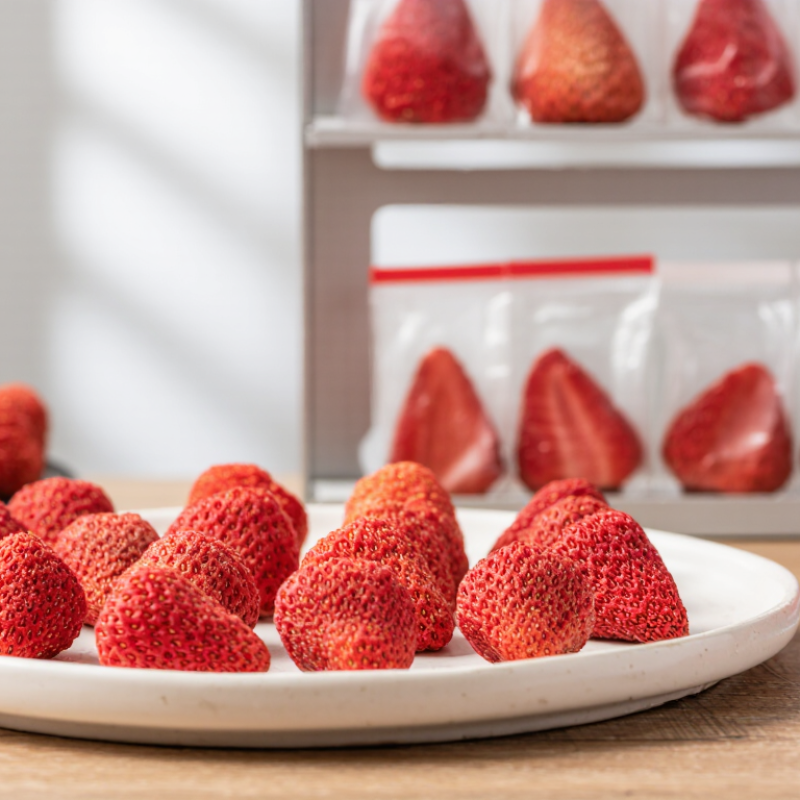
Freeze-dried strawberries begin as fresh fruit containing about 90.95% water, according to USDA FoodData Central.
They are sliced, quickly frozen, and placed inside a vacuum chamber. Gentle heat then changes ice directly into vapor, skipping the liquid stage. This is sublimation. The result is a light, crisp berry with a porous structure and strong natural aroma.
The process usually has three phases: freezing, primary drying, and secondary drying.
Primary drying removes most ice under low pressure.
Secondary drying reduces remaining bound moisture.
Moisture control matters. FDA food-safety guidance identifies water activity below 0.85 as an important control point, although it does not make food sterile.
A professional supplier should provide water-activity results, moisture data, microbiological testing, and clear packaging records.
USDA data shows why processing speed matters.
Fresh strawberries are highly perishable because of their water content. Freeze-drying can preserve shape, color, and many nutrients without frying or added oil.
However, “preserved” does not mean unchanged. Vitamin losses, browning, broken pieces, and uneven texture can still occur.
I have seen attractive samples become soft after poor sealing. That weakness is easy to miss.
Oxygen-barrier packaging, humidity control, and batch testing often matter more than appearance alone. Temperature exposure during storage also deserves attention, especially for international shipments.
Choosing among the 10 best freeze-dried strawberry suppliers worldwide requires more than comparing prices. A reliable supplier should provide consistent color, crisp texture, strong aroma, and traceable origin. Ask for recent samples from several production lots. One attractive sample proves little. Check moisture, water activity, particle size, breakage, and rehydration performance. These details reveal whether the product suits cereal, chocolate, bakery, or snack applications.
Supplier evaluation should include food safety records, laboratory reports, allergen controls, and documented cleaning procedures. Review certificates carefully, but do not treat certificates as complete evidence. Request lot-specific test results for microbiological safety, pesticide residues, heavy metals, and foreign materials. Packaging also matters. Moisture-resistant bags, oxygen control, and sturdy cartons help protect fragile fruit during long-distance shipping. Confirm minimum order quantities, production capacity, lead times, and customs documentation before making a commitment.
Tips: Compare at least three samples under the same storage conditions. Weigh broken pieces after transport. Ask how the supplier handles seasonal crop variation. Verify that labels match the actual specification. Speak with technical staff, not only sales contacts. Keep written records of every claim. No supplier is perfect. Even experienced buyers can overlook humidity exposure after opening. A small trial order may prevent an expensive quality problem later.
Regional Overview of Leading Freeze-Dried Strawberry Suppliers
The strongest freeze-dried strawberry supply regions follow fresh-fruit availability, processing skills, and export infrastructure. FAOSTAT reported global strawberry production at roughly 9 million tonnes in 2022. That volume supports a wide raw-material base, but not every growing region offers stable freeze-drying capacity. North American suppliers often serve cereal, snack, and ingredient manufacturers. They usually provide diced pieces, slices, and powder with documented moisture and microbiological controls.
Europe remains important for premium bakery and dairy applications. Eurostat data shows Spain, Poland, and Italy among Europe’s major strawberry-producing countries. Their suppliers often emphasize traceability, allergen management, and shorter regional transport routes. This can reduce handling risk. It does not always mean lower cost. Energy prices can change the calculation quickly.
Asia-Pacific combines large fruit-processing networks with competitive manufacturing costs. China, South Korea, and Japan supply retail packs and industrial ingredients, while New Zealand and Australia offer seasonal diversification. A 2024 Grand View Research assessment placed the broader freeze-dried food market in a strong growth phase, with convenience demand driving investment. Market estimates vary widely, though. Definitions are inconsistent. Latin American processors also deserve attention, especially where berry cultivation and port access overlap. Buyers should compare harvest calendars, certificate validity, pesticide testing, particle size, and actual water activity—not only quoted prices. Samples can look excellent. Production consistency may still disappoint.
Selecting among the 10 best freeze-dried strawberry suppliers worldwide requires more than checking color and price. Product quality begins with ripe fruit, controlled freezing, and low final moisture. A 2023 review in Foods identifies moisture migration and oxygen exposure as major causes of texture loss and oxidation in freeze-dried foods. Ask for moisture, water activity, microbial, pesticide, and foreign-material results for every production lot. Crunch matters.
Certifications should match the buyer’s risk profile. Suppliers operating under HACCP and ISO 22000 systems offer stronger process control than suppliers showing only a general quality certificate. Codex CXC 1-1969 also supports documented hazard analysis and preventive controls. Request current certificates, audit dates, laboratory methods, and traceability records. Organic or allergen statements need verification, not assumptions. A glossy certificate can still hide weak batch controls.
Packaging often determines real shelf life. The Institute of Food Technologists notes that oxygen, light, and humidity strongly influence dried-food stability. Prefer high-barrier pouches or sealed containers with low oxygen transmission, desiccant protection, and clear lot coding. Many suppliers claim 12–24 months, but this period should come from accelerated or real-time stability testing. Confirm storage conditions, usually cool and dry, plus residual oxygen limits after sealing. I would also test one opened pouch after several weeks. It may not remain crisp, and that uncomfortable result is useful evidence.
| Rank | Anonymous Supplier Profile | Primary Supply Region | Product Format | Quality Specification | Certifications & Compliance | Packaging Options | Typical Shelf Life | Best-Fit Applications | Overall Score |
|---|---|---|---|---|---|---|---|---|---|
| 1 | Supplier Profile A Large-scale export processor | East Asia | Whole berries Slices Powder | Moisture generally ≤5% Water activity typically ≤0.30 Bright red color with low foreign-matter tolerance | HACCP-based food-safety system ISO 22000 or equivalent Allergen-control program Organic documentation available for selected lots | Food-grade inner liner Nitrogen-flushed bulk bags 5–10 kg export cartons Private-label packing available | 18–24 months when sealed and stored below 25°C in a dry environment | Cereal, granola, bakery inclusions, snack mixes, retail pouches | 9.2/10 |
| 2 | Supplier Profile B Premium ingredient specialist | North America | Whole berries Halves Crumble | Moisture commonly 2–5% Strong aroma retention Uniform size grading and controlled color variation | BRCGS or comparable GFSI-recognized certification HACCP plan Traceability by production lot Gluten-free controls available | Metallized barrier pouches Oxygen absorber option 0.5–15 kg case sizes Retail-ready formats available | 18–24 months under unopened, low-humidity storage conditions | Premium snacks, chocolate, confectionery, direct-to-consumer products | 9.1/10 |
| 3 | Supplier Profile C European organic-oriented processor | Western Europe | Slices Dices Powder | Moisture typically ≤5% Low-temperature freeze-drying process Particle-size specifications available for powder | FSSC 22000 or equivalent EU organic certification available for qualifying products HACCP and pesticide-residue testing Food-contact packaging compliance | Recyclable paper-based outer cases High-barrier laminated inner bags 1–20 kg commercial formats | 12–24 months, depending on pack barrier and storage conditions | Organic foods, baby-food ingredients, muesli, functional food products | 8.9/10 |
| 4 | Supplier Profile D High-volume contract manufacturer | East Asia | Slices Chunks Powder | Moisture generally ≤6% Metal detection and sieve controls Custom particle size and blend ratios available | HACCP certification ISO 9001 quality management Export inspection documentation Microbiological testing by batch | Bulk foil-lined cartons Vacuum-packed inner bags 10–25 kg cartons OEM labeling supported | 18–24 months in unopened moisture-barrier packaging | Industrial bakery, beverage premixes, yogurt toppings, foodservice | 8.7/10 |
| 5 | Supplier Profile E Specialty clean-label supplier | South America | Whole berries Slices Crumble | No added sugar in standard formulation Moisture commonly ≤5% Natural flavor and color retention | HACCP-based controls Non-GMO statement available Vegan suitability Organic certification available for selected origins | Nitrogen-flushed foil pouches 250 g–5 kg formats Printed retail bags available | 18 months typical; shorter periods may apply to high-barrier retail packs after opening | Clean-label snacks, smoothie toppings, health-food products, gift packs | 8.6/10 |
| 6 | Supplier Profile F Flexible private-label producer | Eastern Europe | Whole berries Halves Powder | Moisture generally ≤5% Batch color sorting available Typical foreign-matter limit controlled through optical and manual inspection | BRCGS or IFS-style food-safety certification HACCP plan Batch-level certificate of analysis EU food-law compliance | Stand-up pouches Zip-lock retail bags 1–10 kg foodservice cartons Custom artwork support | 12–18 months, subject to packaging specification and storage humidity | Retail snacks, online marketplaces, bakery decoration, gift-box products | 8.5/10 |
| 7 | Supplier Profile G Value-focused bulk ingredient supplier | Central Asia | Crumble Dices Powder | Moisture commonly 4–7% Cost-efficient mixed-size grades Standard microbial and heavy-metal testing available | HACCP-based system ISO 22000 or equivalent available for production site Export health certificate where required Allergen declaration supplied | 10–25 kg lined cartons Polyethylene inner bags Bulk pallet shipments Customized granulation available | 12–18 months in sealed packaging under dry, cool storage | Protein bars, instant beverages, fillings, industrial food manufacturing | 8.2/10 |
| 8 | Supplier Profile H Small-batch premium processor | Oceania | Whole berries Slices | Moisture generally ≤4% High aroma intensity Manual visual selection for premium grades | HACCP program Food-safety audit reports available Allergen and traceability records Organic claims subject to product-specific certification | Foil-lined pouches Small retail jars or bags 100 g–2 kg formats Limited bulk capacity | 12–18 months unopened; resealing is recommended after opening | Premium confectionery, specialty cafés, gourmet retail, culinary decoration | 8.1/10 |
| 9 | Supplier Profile I Regional agricultural cooperative processor | Southern Europe | Slices Dices Crumble | Moisture typically ≤6% Seasonal raw-material variation disclosed Standardized cut sizes for bakery use | HACCP controls Farm-to-lot traceability Residue testing according to destination-market requirements Vegan and gluten-free declarations available | Kraft cartons with food-grade liners 2–15 kg formats Recyclable secondary packaging | 12–18 months under dry storage below 25°C | Bakery, cereal mixes, seasonal products, foodservice applications | 7.9/10 |
| 10 | Supplier Profile J Emerging export supplier | South Asia | Powder Crumble Slices | Moisture generally ≤6% Competitive pricing for processed formats Product specifications customizable by order | HACCP-based manufacturing Certificate of analysis supplied per lot Microbiological testing available Destination-market documentation should be confirmed before purchase | Foil-lined export cartons 5–20 kg bags Palletized shipment Private-label packing available for qualifying volumes | 12–18 months when protected from oxygen, moisture, heat, and light | Powdered drink mixes, fillings, bakery products, cost-sensitive formulations | 7.7/10 |
Choosing among the 10 best freeze-dried strawberry suppliers requires more than comparing price per kilogram. Your product format matters. Bakery fillings need consistent particle size, while snack mixes need bright color and crisp texture. Ask for samples from at least three production lots. One sample can hide seasonal variation.
USDA FoodData Central lists freeze-dried strawberries at approximately 357 calories and 28 grams of fiber per 100 grams. However, nutrition values can change with cultivar and processing conditions. Request a current specification sheet, not a recycled brochure. Check moisture, water activity, broken pieces, foreign-material controls, and microbiological limits. The FDA Food Code identifies water activity as a major factor in controlling microbial growth, so suppliers should provide verified testing records. I would treat missing water-activity data as a warning.
Reliable suppliers can explain their HACCP plan and align production with Codex food-hygiene principles or ISO 22000 systems. Ask how they manage allergens, pesticide documentation, traceability, and recall simulations. Packaging also deserves attention: high-barrier pouches with oxygen control protect fragile fruit during long transport. The FAO reports that food loss remains a major global concern, making efficient packaging and storage commercially important. Still, certifications do not guarantee perfect deliveries. I once underestimated lead-time risk because the audit documents looked impressive. Include delivery history, minimum order quantity, private-label flexibility, and replacement terms in your comparison. Score evidence, not promises.
This procurement weighting model reflects the main factors businesses commonly assess when comparing freeze-dried strawberry suppliers worldwide. Food safety, certifications, and consistent product quality receive the highest priority, while pricing, capacity, minimum order quantity, lead time, and logistics should be evaluated according to your business requirements. The percentages are an editable evaluation framework, not market-share data.